 The front man for Devo speaks on art, selling out to Swiffer, working with Wes Anderson, and everything Devo from its beginnings to the possibility of a Devo movie?! Andreas sits down with him in LA for this incredible and meaty interview.
Mark Mothersbaugh: I'm excited about this now, because this is brand new. It all goes back to Devo (laughter), no I'm kidding. But it actually does, in a way, because the one thing that everyone in the band has determined is that everything we've been doing since we started Devo has been permutations on the same theme. So, you know, it's all kind of Devo; it's all Devo.
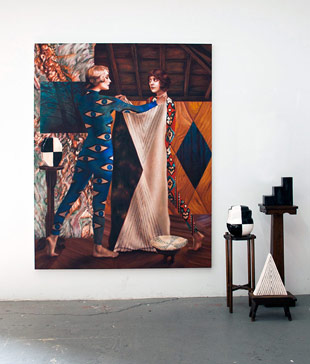
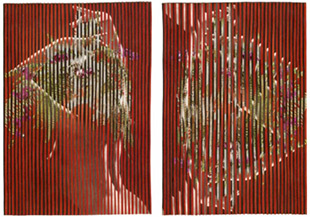
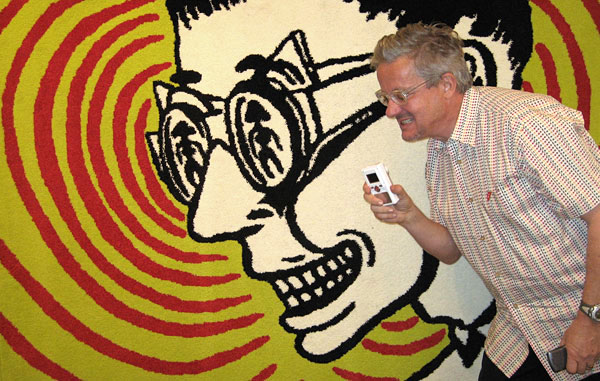
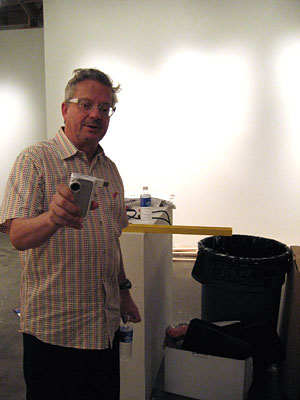
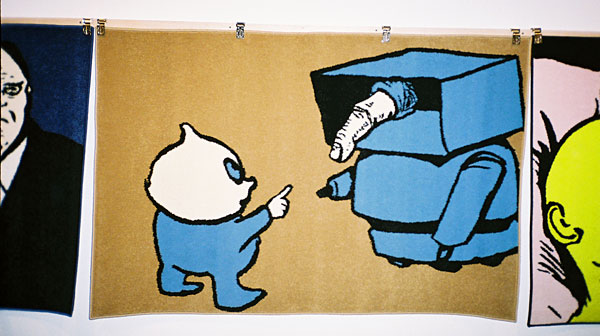
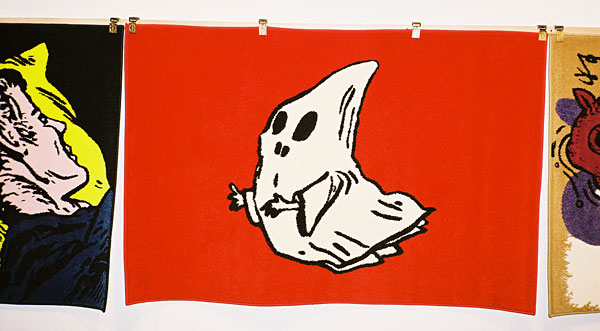
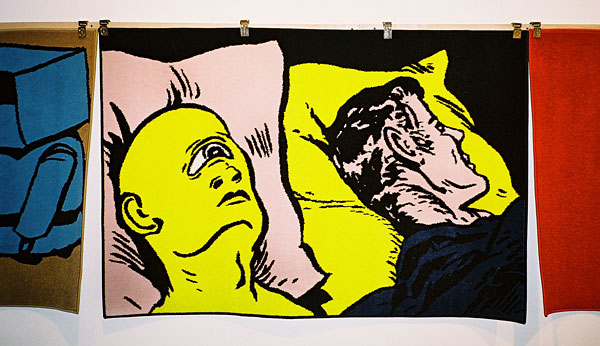
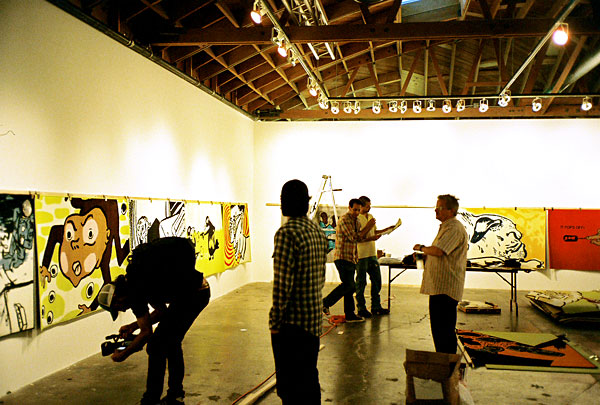
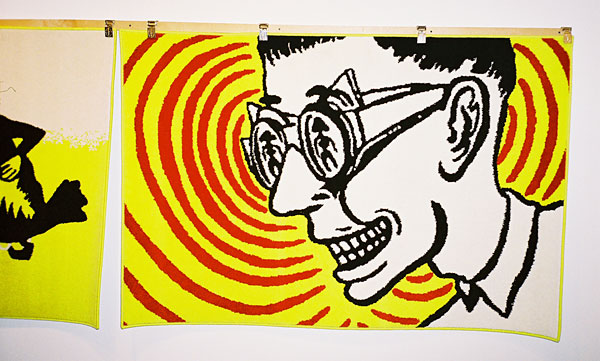
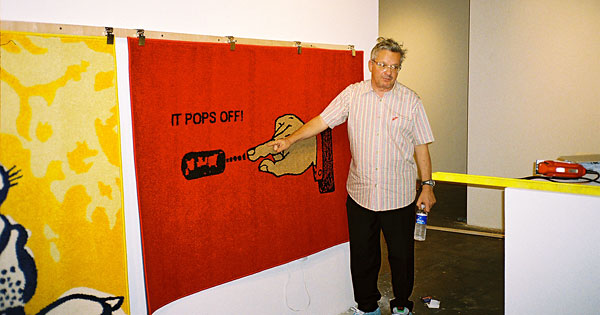
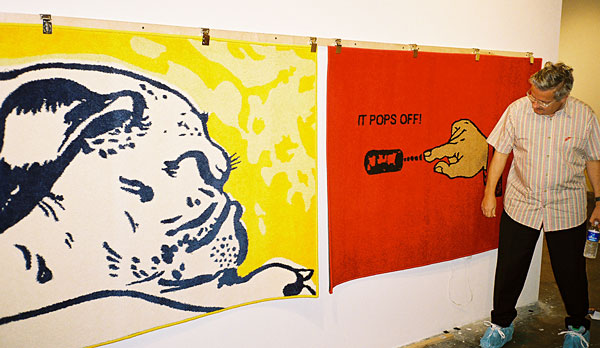
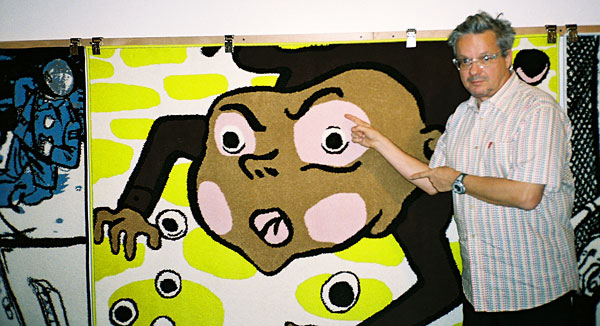
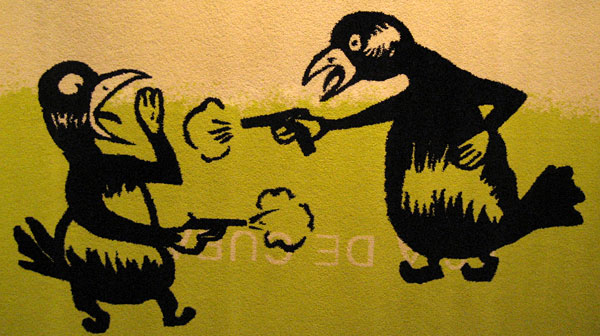
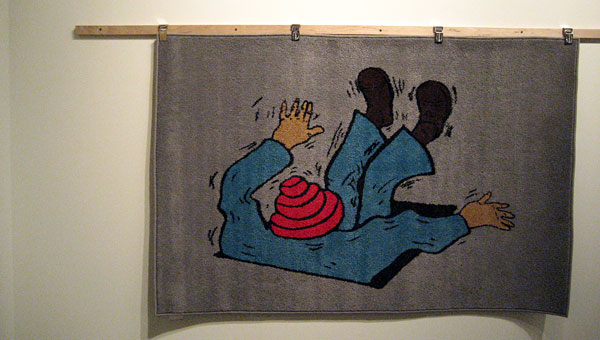
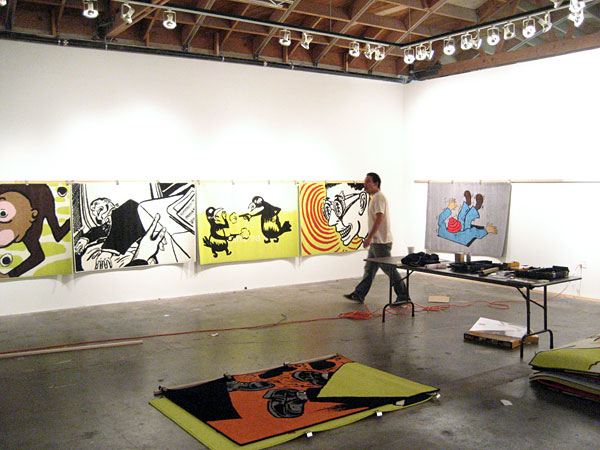
But this show is, for me, it's kind of exciting because... I only in the last year decided I was going to show these rugs. I've been making them since about 2002, so like about five years, and I made one or two rugs about 12 years ago. I made an entry way rug for my recording studio, and I like them and you walk across them every morning and you go, "Ah, there's the logo!" and then you go up the stairs and I've always thought they were nice. And about five or six years ago I was doing gallery shows and I just kind of was like, "Ok, paper and canvas... " and was just kind of thinking about mediums to work in, and I decided that I needed some rugs at my house because I put in a wood floor in my house and so I needed a rug to go over the top of it because it was too noisy once I went from having this funky carpet down and I ripped it up and I put this bamboo stuff down, which was kind of inexpensive at the time, and then it became really noisy so I put a couple of rugs down. And I used my own design and they're functional, but it's just nice to see somethingI went shopping for rugs and couldn't find anything I likedso I put some artwork down, and it was kind of nice to walk into a room and instead of looking at a wall for artwork, you were looking down at the floor and interacting with it when you stood on top of if. My daughter learned how to walk on one of my first carpets that I madeit's in the show and, we tried cleaning it the best we could, but there's even puke stains and baby food stains on... (Mark's phone rings, he's got a Devo ringtone. He's maybe the only person in the world I could imagine getting away with using his own music as a ringtone)... (into telephone) Hi! (I leave out the one-sided phone call.) Ah marriage! It's a beautiful idea, in theory.
What's great, I realize, is that Mark is still an awkward nerd at heart. Nothing he does will betray this image that I've been carrying around for years and years.
I like the idea of it being just part of the room as opposed to something being specially framed, and kind of not as connected. Once I saw my rug there with a baby stroller on top of it and toys strewn on it, it made me happy. I liked my art interacting with real life, and so I got excited about it and started doing a lot of rugs. A year ago, my wife, who's also in the entertainment businessshe's an agent for film composersI was saying, "You know, I'm getting tired of the film business," and we were talking about doing something else and so we became partners with somebody in a house wares company. And I'd already been doing these rugs and so it seemed like a natural thing that we would do. And so, probably, we're going to make them for sale besides just doing gallery shows. So it's kind of an exciting show for me because it's going into territory I'm not familiar with.
M: You know, it's like what happened was we needed some plates for our house. And I was looking around at plates and they all sucked. Plates, if you think about it, they're not that interesting most of the time. And I saw some plates in Wired magazine or something, like "Here's a few things you should buy," and so I was looking, I said, "Oh, plates! I need those!" And they were Rorschach prints; this woman had done Rorschach prints on plates, and that's kind of like what I do with my photographs. I don't know if you know that, but I do gallery shows with photography too, I could show you some of that, which doesn't really have anything to do with this show that much, but it was kind of similar, the Rorschach things, and so we bought some plates from her and then we looked at other stuff she did and we liked it. Then we got in a conversation with her, and she had a company she'd started and it had won some prizes for design, but she needed partners. She was swamped filling out orders and things, and we were just trying to start to get in the business so we thought, "Well, we've got something to offer each other." So we became partners with a company called Wallteria Living. It's kind of interesting. We'll see what happens. Hopefully, Devo hat-shaped toilet bowls; things like that. I'm not sure what's going to happen next but you can only hope...
Right here, seriously at this moment, I kind of cringed. He'd lost me already. Was his humor this dry? Was he being funny re: the Devo toilet? Was this a kind of meta-irony? Ask yourself that before deciding if any of my questions came off as critical.
M: Not at all. In fact, we used to get criticized back in the early days of Devo because, to us, what we were about, back before it was very cool to be into merchandise, we thought of our album cover as a place where we could do the inner-liner sleeves... as a matter of fact, if you look at any of the old Devo records, our inner-liner sleeves were always a merchandise page. We thought of it like the back page of a comic book where you'd see all the things you could order. Smith-Johnson novelties, stink bombs, baking powder-propelled rockets and X-Ray specks and all that kind of stuff. I loved that page of a comic book every time and I always looked at that stuff and sometimes would order it, and the Devo albums, we wanted them to be like a Cracker Jack box where you'd have a prize in there. I remember in 1978 when we put out our first album, and somehow our manager also managed Neil Young, and I remember Neil Young going, "You guys, I don't know what you're doing bringing merchandise into rock n rollthat's so uncool!" "Of course now, all these years later, he sells a ton of t-shirts and DVDs and things. But at the time he thought it was kind of sacrilegious, and we're like, "You don't understand! This is all fun! Rock n Roll is better than that!" It's like, everything that turned you on when you were a kid, you should still be able to be part of it. So for us, we thought the merchandise just had to be smart instead of stupid. So we tried to do smart merchandise, and I'm still trying to do smart merchandise.
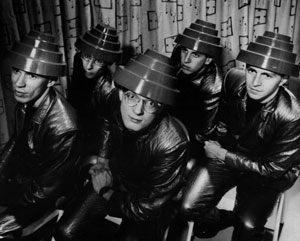
That's what that is. At least we did cool things. We did the red energy dome, which was useful besides being an iconit was a useful icon. You probably know this very well, but your orgone energy goes out the top of your head (At this point I realized he was being 100% sincere and I truly had to bite my lip a bit to keep from giggling. But still, I was in awe of the guy.) and it dissipates out the top, but if you wear an energy dome it recycles that energy. It comes back down and showers back down on you and, among other things, you remain manly, shall we say, for maybe another 150 years of your life, probably. I think that's a safe prediction to say that energy domesif you wore them constantly, night and daywhich I don't do, but there are people out there who do, not too many of them but there are some. We get e-mails from them, so we know they're out there, those people will probably live about an extra 150 years because of all that orgone energy that they're saving and not wasting away.
M: I don't care about the billionaire buyers, that's more of the cocaine days I think. And some of those artists I like their stuff; I love Jeff Koontz, I think his stuff's great. All the Michael Jackson and Bubbles and his stuff with Cicciolina, you know... so I mean, I can't say that I hate the artwork but as far as what I try to do with my artwork, it's totally the antithesis. About seven years ago when I started being really aggressive about doing gallery shows again, because I hadn't done them since the 80s, I went to Juxtapoz Magazine. First off, Robert Williams was a friend of mine when we were younger and we did gallery shows together, but I just really liked the magazine. I liked its interest in street art, in comic book art, in graffiti art, and skate art, and youth-oriented art. And it was kind of like, "Fuck the money people! We're here to talk about what's really important in the art world," and although Juxtapoz doesn't cover the whole art worldthey only cover one kind of thingit was a doorway for me. Instead of looking in the back of Art Forum and not finding anything interesting in the way of galleries there to contact, people that would have seen my stuff and would say, "What is that? My lawyers and bankers and dentists and investment marketing analysts aren't going to want to invest in that kind of stuff, they want abstract art, impressionistic art."
So we didn't have anything. And there were all these galleries in the back of Juxtapoz; that was the good thing about Juxtapoz. Whatever limitations it has, being overly obsessive about dice and Bettie Page and some of the stuff where you're just sort of like, "Okay, we've seen this issue for five years now! We've seen the same shit already!" But they had all these galleries advertising. For $20, a little gallery in Wisconsin, a couple guys who just got out of school and they were still excited about art, you know, they're like, "We know we're going to get trumped by the real world, but before that happens we're going to take the last bit of money we've got and open a gallery in some shit section of Minneapolis or Cincinnati or something, and we're going to do a gallery for the art that we like."
And they would show graffiti artists and they would show comic book artists and Kid Robot-style toy artists and things like that. And I'd call them up and it would be symbiotic; we were good for each other. They'd say they like my artwork and for me it was a chance to be around people that were still excited about the art world. I was going to be showing at galleries where people were thinking of art as something exciting and important and not just as a business investment.
I did my first show a couple of months after 9/11 and I'd been thinking about it and I'm going to name my show Homefront Invasions, and what I meant by that was that I wanted my artwork to go into people's houses around the world and I wanted to go into their living rooms and hang across from their television set so they'd be sitting there eating popcorn or smoking a doobie, or whatever they did at night when they got home, and there'd be a piece of art that they could look at. Or in their bedrooms, wherever it was going to go. And the people I wanted it to go to were young people that are still excited about art and feel like I felt in 1975 when I was first doing Devo and we'd stay up all night just trying to get one thing right on a little shitty tape recorder. The quality was going to be terrible anyhow, but it was so important for us to record Mongoloid or something that we would stay up all night working on it. We weren't getting paid, we were just excited about art.
And so I started showing at these galleries and I met a lot of really great people, and so I priced the stuffI thought, we'll I'm not going to do original paintings because I'd have to sell them for so much, so what I started doing was taking images that I'd painted or drawn and I would make prints; I'd scan them and put them into the computer and I would add things to them, and then I would make a limited edition of three prints. I'd keep one for myself and I would sell two of them and I priced them as cheap as I could. And then I went one step better, I was kind of worried because I know that the last time I bought a piece of art at a gallery and they framed it for meand I remember buying a piece of art that was like $700 but the frame cost me $850 for like a piece this bigso I thought we're going to defuse that right away; we're going to make it so cheap, I bought frames out in the Valley and I had them frame things uplike 300 pieces of art at onceso that I could get them super cheap and people could come into the gallery and they could buy a piece of art for somewhere between $100 and $1,000 tops. But you know, a lot of $300 and $400 price range pieces. So like some guy that was at school, or just out of school, could go, "Let's see... I could either buy a keg for a party this weekend or I could buy my first piece of art." And so a lot of people told me that the first piece of art they bought in the past eight years was one of my prints, and I made them cheap for that reason.
To me, when you talk about the high-end of the art world, about who Damien Hirst is and his diamond-encrusted skulland I love the idea that he couldn't sell it and he panicked and he bought it himself for some mysterious amount of money with some investors, so who knows what they really paid for it? Probably nothing. But I love the idea that it went so far that even the pigs of the world choked on it.
M: That's what happened. I thought that was great. But that's something else. I guess that's an art in its own way, and that is related to the old world of art. So I think a gallery, like Scion for instance, or Pulp in New York City, or any of the hundred galleries around the country that are small and are just a couple of guys that have a place about a fourth the size of this or smaller and they don't even know if they're going to be able to pay rent for the rest of the year. They're just hanging on and a couple of sales would be all it would take. I'm good for them because those are the kind of galleries that don't get any respect in their hometown; the people there go, "You're not a real gallery. You're just a bunch of kids on skateboards." They can get the local newspaper to write an article that says, "Mark Mothersbaugh from Devo, and he wrote the music for Rugrats and Wes Anderson," so then they're a little more legit.
So it actually worked out really good for both of us with a lot of these galleries. I kind of helped them and they helped me. And for me it's just great; I like the joy of being around the people in Raleigh, North Carolina or Orlando, Florida that still really give a shit about art and still are really turned on by it.
M: Is it manipulative? Yes. And it's consciously manipulative and it's done specifically for the purpose to get people who are stupid and lazy and don't want to get away from their desks for a little, dumpy gallery because they're like, "These people don't deserve recognition." I think it's a legitimate way to get people into a gallery. I don't think it's a bad thing. And you know what's going to happen? They're going have this old guyMark Mothersbaugh, you know, from Devoone month and they'll get some reporters down, but the next month what's going to happen is they're going to have more kids from Detroit or whatever city they're in, and the newspaper this time will go, "Oh yeah, they already had a show where they couldn't fit everybody in; they had to turn people away last month. So let's go see what's going on there."
And you know what? A lot of those people that come down for a show to see Mark Mothersbaugh, they'll come down the next week and they'll see what the local guys are doing. And I don't think that's a bad thing.
M: Oh yeah. You know what? There's different kinds of artists and I think there's a large contingency of artists in the world that make their big statement, whatever it is, when they're young. When they're young angry men. And people that still stay in touch with that, they do permutations on a theme. That's what I think. And I think that Jerry and Bob and Bob and I are still Devo, whether we want to be or not. I think everything we do, it's still through that filter. We're still about the same things we were about then. Devo was really angry and upset with stupidity, and we were anti-stupidity and we would point it out everywhere we saw it. Especially when it was in places of power, like our government or in social and cultural arenas.
We were pro-information. We are four kids finding out about what was really going on in the worldwhat was going on in their worldand encouraging them to make decisions based on information rather than just mindlessly saying, "Oh well, I saw a poster and my Dad said I should join the army and fight for George Bush." Maybe you should think about that and think about what you're doing and why you're doing it, and have a lot of informationmore than just, "Oh, there's a boogeyman over there who's got nuclear bombs and he's about to attack the United States!" You know, whatever lies George Bush used so that he could line the pockets of his cronies. He's the biggest thief we've ever had in the United States; he is the president that has stolen more from the American people than any other president. It's kind of amazing what he's managed to do in the name of freaking people out; scaring people into believing that there was a boogeyman that wants to come over and kill all of us. And he's made it even worse. He's created all sorts of boogeymen that all want to come get us. America's never been as hated as it is now. If you go around the world, more people hate us now than they ever did.
M: He squandered your money. You're a lot younger than I am, and you'll be paying for the bombs and the ships that went over there to blow people up and just explode in the sky, you know, you'll be paying for that for decades to come.
M: Yeah. Well, when we first started saying, "We don't think we're watching evolution take place, we're watching de-evolution." Back in the 70s, people would get really upset and go, "You guys are assholes! You really have a bad attitude about the world! You guys are fucked up!" Now when you say to people the world's devolving and things are falling apart, they just turn their ball cap and take a hit off a joint and go, "Woohoo! We're going down!" and they know it. They know we're going down.
M: Oh, wait a minute! I don't think that's a real story! It might be a parody.
M: I think that had to be a fake story (laughter).
M: Go back and look for the source (laughter); I think that's got to be a fake story. I read it and I couldn't (laughter)... it's kind of... it's the English version of something comparable to The Onion. I don't know where I read it. It was like the London Financial Times or something. I read it somewhere and it was a pretty good story.
M: No! I mean yes...
M: Yes. How and why?
M: Yeah, the Swiffer one. That was the one, for me... but you've got to understand that... here's my feeling about thatI grew up during the time of the hippies and so the one thing I took away from the hippies, and also Jerry and I were protesters, I joined Students for a Democratic Societycommunist youthwe were idealistic. We thought ending the war in Vietnam and Cambodia was important and we thought communists had ideas. I know better about communists now.
But one thing we learned is that rebellion is obsolete. The punks should have learned from the hippies. Rebellion is obsolete. The hippies just became commodified by big business; they just got sucked in and became hip capitalists. And the same thing happened with the punksthey just turned into a fashion statement and became irrelevant. The only true way of change in this country, especially because now technology has just allowed Big Brother to become stronger than he ever was, I mean they can pinpoint any conversation they want, anywhere in the world they can just zoom in from outer space. They can come down and they can drop a bomb on the four of us here right now if it had some purpose for them. I know that sounds paranoid, but the truth is carrying this thing around (indicates cell phone) is like taking your own Lo-Jack for the government with you. You trade off freedom for the freedom of not having a cable on your phone.
But... where were we going? What did we start off talking about? The ad songs? Yeah. Okay. So our feeling in Devo is that subversion is the only way to really change anything. If you want to learn something from the Vietnam era, look at who the winners were. And that was the Viet Cong. They had the least amount of resources and they made the maximal usage of them.
M: Yeah, they had the most to lose, but they won. They won. It was guerrilla techniques and subversion, and that's how you change things in this culture. And when I first started doing commercials I sued to put subliminal messages in them all, and then it became too easy but every now and then I think I'm going to do a gallery show because I have about 50 commercials that I put subliminal messages in every single one of them.
M: Yeah. It just got to be too easy, and I only got caught once really.
M: It never came out because I had to take it out. The film editor for Red Car, the editing house in Hollywood, they told me they were going to tell Daley and Associates. They said, "You know, you put something in there that isn't part of their message so you should... " and it was just something one of those things from the B.F. Shattuck pamphlet on de-evolution, the Jocko-Homo pamphlet, it was just one of the absurdist rules about laying an egg, or give birth to one, and so shall your species survive. But I put things in like "question authority," and "candy is bad for you," or "don't trust your parents all the time." Stuff like that, and it was amazing because people would sit there and go, "Yeah! Yeah!" and there would be like a Keds commercial for Keds tennis shoes and you go (hums a jaunty tune!) and you'd hear "something is stupid." And Bob Casale and me would get really embarrassed, and even if I knew nobody could hear it and nobody was paying attention to it my ears would turn red. And he said, "You always give it away! You always turn bright red right when the subliminal message... "
But people would sit there tapping their pens on the table, these guys from the ad agency, and they'd be going, "Yeah Keds!" And I even forget what the theme was for Keds because I've done so many hundreds of commercials now.
But so that's how the Devo commercials came about. We decided to go ahead and let them [the songs] go into things. We though the thing that could happen is that people would become more aware of Devo. The fact that somebody uses Devo in a commercial, in the first place, to me is ironic and it means that they just thought of Devo as a kick-ass dance band or something. They never really considered what we were talking about. So we had a record company that worked hard to keep it that way. They didn't understand us, and they didn't like it when we told them what we were about. So they would put out press releases saying, "Those quirky, whacky... " They used the word "quirky" all the time to make it sound like anything we had to say was either nonsense or unimportant. But we just did what we did. And as far as commercials, I thought "Beautiful World" was used ironically in a really great way.
M: Yeah. That's the thing, I don't think they even know what they did. And they're oblivious to it because they're just these people that are selling tons of shit so they don't even pay attention. So that was fine with me. There are other things that we did that I think fall under more subversive categories... we did something last year with Disney called Devo 2.0.
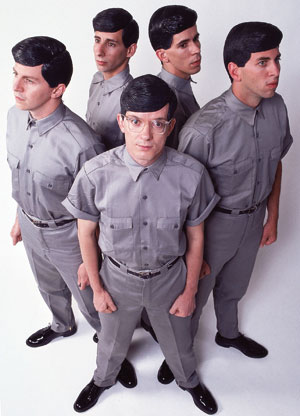 M: When we first started Devo, we didn't think of ourselves as the musicians in the band. Jerry, my brothers, and I, we wanted to make films. This was before Mtv. We had seen laser disks. In 1974 we saw a picture on Popular Science magazine and we were like, "Laser Disks! They're going to kill rock n' rollthat's what we want to do! We want to be part of that!" They were the same size and shape as a vinyl LP, but they had pictures along with the music. And so we wanted to make a product for that, so we started, on all of our songs, making a film to go with it and we just kept preaching about sound and vision and music television was going to come along and it was going to change everything.
We were naïve enough to not realize that when Mtv came along it was going to be this sinister Big Brother, the sinister left arm of record companies, and it would just allow record companies to last another 20 years longer than they should have. And they just made stupid videos. Most of them were awful and moronic and had nothing to do with what we thought we were doing when we were making films.
But the Devo 2.0 thing, what I liked about it is that we got these little kids to sing our songswe played all the instruments but the little kids sang and made a little band togetherand now there's four and five and six-year old kids that are listening to Devo songs and they're reciting the lyrics. Just in my own house, I have a three and a six-year old, and they'll sit in the car and they'll go, "Devo, Daddy!" That record. The youngest girl, I adopted her two years ago, so she's been to a lot of Devo shows. She even, one night when my wife wasn't paying attention, she ran out on stage and was like, "Daddy!!!" So she knows that Dad's in Devo and she's been to a lot of Devo shows. The older daughter, I just adopted her about five months ago, and so she only spoke Chinese when I first met her. She now speaks English pretty great, great enough that she's now in Kindergarten. About a month ago we played at Newport Beach and she came to that show and she's never been to a concert in her lifeshe's six years old and she was destined to be in a factory, working for Nike, gluing labels on skateboarders' tennis shoes, and then we plucked her out of there somehowand so she's sitting in an audience at a concert and she's like, "Why is Dad up there... with a yellow suit on and a red hat?" She was totally confused. She still doesn't get what Devo is, I'm sure. The older one doesn't really get it. The little daughter, she kind of understands that Daddy was in Brazil last weekendhe was Devo last weekend. "Daddy, you were Devo!"
The older one, she's still kind of confused about it, but they sing the songs and they know all the words and they watch this 12-year old girl, who's probably going to be another horrible Lindsay Lohan in about three years, but right now she's this cute little girl who's singing Devo songs. And my daughters, they just do the same moves and they have all the Devo lyrics embedded in their heads now. I think that's the most subversive thing we've even done and I was kind of impressed at how well it worked.
M: Oh yeah. But to me, what that means is that when kids that learn with the lyrics slightly changed on about three of the songs, they're going to someday hear the Devo version and they're going to be singing along and go, "What's that??" and then they're going to listen to it again and then they're going to go, "That's a clue. There's something there." And they're going to want to know why somebody made a change and what's important about it.
To me, I think it'll be like when I was a kid and I bought the single "Satisfaction" by the Rolling Stones and I listened to it over and over on a 45, that's what the technology was in those days. So I'm listening and this woman comes over from my Mom's church and I'm just sitting on the floor, minding my own business, I'm in 7th or 8th grade, and I'm listening to the Rolling Stones, and this woman comes up to my Mom and goes, "Mary, why do you let your boy listen to that music? It's dirty!"
And believe me, I listened to that song a thousand times after that. I mean, what's dirty? How do I get it? What is it? I was even more excited about the song and it made me more into it, to the point where I became so into "Satisfaction" that it's the very first song on the very first album we ever put out. That's how much it meant to me for something like that to happen. Like some cop giving me a clue that you shouldn't know about that! That's a secret! That kids aren't supposed to know about. So I think Devo 2.0 is a good thing, and I say praise subversion as a way to change things in this country.
And maybe Swiffer is so horribleI almost want to just put the Swiffer video on in front of us when we come out on stage because it's so hideous! That woman dancing with the fucking Swiffer! And the Swiffer is an awful product anyhow. I bought one just to try it out and I put it on my floor and whatever the stuff was on my floor, it discolored the shit out of the paint on my floor. I was like, "This isn't safe for anybody! This is a horrible product."
So that's the one I've really disliked of all the commercials that we've ever had our stuff used for. But it was definitely a hideous combination of capitalism, consumerism, and de-evolution all in one 30-second spot!
M: Well, probably not as much as he would have liked. And the way in which he was influential was that he paid for the album. We didn't have a record deal and I, in an article, had said that he was my first choice as a producer. I said I wanted it to be either Brian Eno or David Bowie, and both of them came to see us in New York and they both said, "We want to produce you!" So Brian Eno said, "Look, it's going to cost $50,000 to fly to German and record an album. I know we'll get a record deal, why don't I just pay for a record and so why don't I just pay for the record and we won't have to wait until next year to do this?"
And so he flew us over to Neuenkirchen, to Connie Plank's studio, the place where he did his Music for Airports and where he produced a bunch of other people. And that's how it happened. He was a really great guy, but the odd thing about it was that he kept wanting to play on the record and so when we were doneand we'd been playing the songs, by that point, for two or three years and we must have been a pain in the ass because we were so maniacally positive of what we were doing, and we were really strong in our vision and what we wanted the songs to sound likeand so he would play a synth part, and we'd kind of pretend, "Oh, that's nice, Brian!" But then when it came to the mixes, I remember I was always going, "Just a little lower on the Brian Eno track... and it's gone."
I know he was a little disappointed that we only used his synth part on two different tracks, but about five years ago I was transferring the 24 track masterbecause it was falling apart, the tape's oxidizing and the magnetic shit was just dropping offso we were transferring it to digital and in the process I was going through Brian Eno's handwritten notes, they were all very beautiful and meticulous, and I realized he played synthesizer on every one of our songs and we only used it on two of our songs. I wanted to call him up and say, "Brian, remember like 25 years ago... when you made all these synth parts? What did you think the album should sound like? If I sent it to you, would you remix it?" And I never did, but that's one of the things I have a desire to do is to let him mix the album the way he wanted it. He probably doesn't even care anymore. He's probably like, "All right, those little smart-ass idiotsI'll just let them do whatever they want to do and I'll get out of here."
Him and David Bowie came over to Germany with us, and I'm grateful, I'll always be grateful to them for helping us do our first record.
 M: Yeah, we were in the record industry in a different time. We saw the tail end of the good days before it got really dark. We were actually at Warner Brothers at a time when they had bands that were just art bands; bands that didn't really make money for them, but as long as you didn't lose too much they didn't care. We were always in the black from our first album on. We never made as much money as Prince or Madonna or something but they just thought, "Okay, we'll sign them because David Bowie said we should sign them. We've already got Captain Beefheart and we got Frank Zappa, and neither of those guys make very much money but that's fine. We got some art bands and Devo's one of them."
In those days a big label like Warner would have a few of those bands, so nobody paid attention to us. They let us do what we want. We stayed in the black, we never went into the red and lost money for the record company, but after "Whip It" was a hit it was like a double-edged sword because all of a sudden they were like, "Wait a minute. We don't pay these guys very much money and they bring in a profit. Now they've brought in a gigantic profit. We just made $20 million off of them, so let's go see what they're doing at their studio." So they came over when we were recording the next album and they were like, "Hey, do whatever you guys want to do, just do another "Whip It."
And we said, "We'll play you what we're doing," and we'd play them songs off the third album and they were getting nervous. Then we were at Record Plant and I remember we'd been reading in one of those trash magazine by the super market check out, and there were articles at the time about John Hinckley, the guy that stalked Jodie Foster and then tried to shoot President Reagan to prove his love for Jodie Foster. And they started printing all these poems he'd been writingthese love poemsand they were great; they were totally Devo.
One of them was, "I pledge allegiance for your love and the thought that you're all that matters." It was this great poem that he'd written and we called him, we were like, "Where's he at?" and they go, "He's in the Maryland-Bethesda Mental Hospital because he was found guilty of trying to kill President Reagan." So we called the hospital from, not Record Plant, it was Cherokee Records, which just now closed down finally last week, and there was a closing party last week for Cherokee Records, but we called and got through to John Hinckley, and we're talking to him, and we were like, "We're big fans of your poetry," and he goes, "Oh yeah? I'm a fan of you guys. I got your first album." (laughter)
We're like, "Oh, that's great. We want to know, what would you think if we put music to one of your poems, one of your love poems for Jodie Foster?" And he goes, "Why that'd be wonderful. Send it to me, I want to hear it." So we sent him a song, and he goes, "Okay, I like that!" so we signed him up. He's one of the only people signed to Devo publishing other than the five members of my band; him and my Dad are the only other two people that are signed to our company. And we immediately started getting phone calls from the FBI. Of course then they called Warner Brothers records and they called our manager, and they're like, "What are you thinking? What are you doing writing that song? Do you know how many death threats he gets every day? Everybody's going to hate Devo!"
But it was this love song, and I just wanted to be able to play this love song on the radio and people would go, "What a beautiful song!" and then [we'd] go, "Oh yeah, John Hinckley, Jr. wrote the lyrics, the guy that shot Reagan." So we ended up putting the song on the record, but it wasn't good enough to be the hit song on the record but the lyricsit was probably more the music's fault rather than the lyricsbecause his lyrics were excellent. And wrote a different final verse and a different chorus, but we used his verses, his verses were great, but we kind of lost touch because the record company had such a fucking hissy fit over it that it wasn't worth it. It was kind of a one time art project, anyhow.
 M: Actually, we're toying with the idea of doing a film and as it happens it could be really funny because it would be based onwhat's the Kurosawa film where the couple are going through the woods and the thief stops them, and he either rapes the woman or doesn't rape her, depending. They tell the story then, because the husband gets killed, they tell the story through an observer, the thief, rapist, and the woman; they all tell a different story, so you see the story come back three times. Three different people's point of view, and it's always totally different each time.
So we're doing itwe worked with a writer who interviewed all five of the Devo guys. We let each person tell their version of the early Devo days from the time we started up until we get a record deal. We want to end up writing it so it's five different stories. It could be funny if it happens.
We're working on an album right now, so if that comes out any good we'll put it out next year. So we'll see... that could be bullshit. How many bands have you heard do a new album where you went, "God, I wish I didn't have to hear that. I just want to remember them how they were." So if we do this, we're going to find people that we think are objective enough that they'd be honest. If they say, "You know what? Don't do it," then we won't do it.
We did something that was important to us at one time, and it's complicated being in a band; it's not that easy. Have you ever been in a band? You know what I'm talking about. Depending on how many people there are, it's like a marriage if you had a marriage with four or five people. It's more complicated than two people. We'll see what happens.
Sometimes people do an album again, like Kraftwerk, but Kraftwerk you knew it would have to work because they only did one thing and what they did was very close to every other [Kraftwerk] albumkind of like what AC/DC did for heavy metal and the Ramones did for punk, but I don't know if we could do that. But we're going to see if we can be Devo again. We play better now than we used to play, so maybe it could happen.
M: Thanks. I'm kind of excited about it because it's a different, weird medium. It's kind of a new place for me to go. I hope I'm not making a mistake. I'm kind of excited about it.
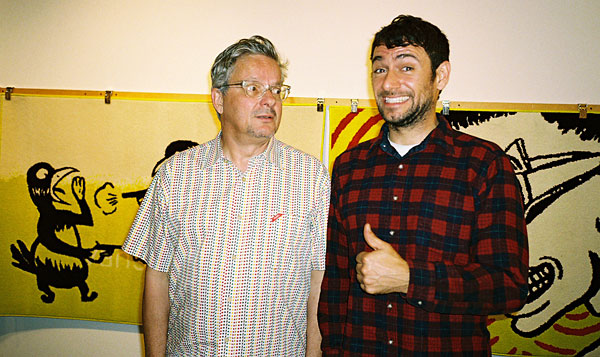
But here's the thing, the thing that made this interview goodthe thing that made sitting down with this man and just talking, good: I left feeling as though I had just as many questions unanswered as I did upon arriving. Who cares about easy answers and having things pedantically explained to you? Isn't it much more important for you to decide for yourself? I could sit here and have after-the-fact misgivings about letting Mark off the hook so easily for selling Devo songs to Swiffer; I could sit in front of my computer and type a litany of reproaches and smugly have the last word. But I don't care to. I'd rather just let the essential questions hover out there and have a life of their own. Who cares about answers when the questions are so much more interesting?
And so it goes.
Many thanks to Evan Cerasoli and Scion. But especially Mark Mothersbaugh. Not only for taking the time to do this, but for Devo. It's okay for me to fan out now, right? The interview is over and I can go home and not have to be objective anymore. Sometimes the words just get stuck in my throat.
-Andreas Trolf
{moscomment}
| < Prev | Next > |
|---|